

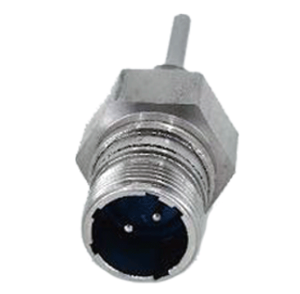
Thermal protection in aerospace and other harsh-duty, high-reliability systems has historically relied on discrete switching devices that indicate when a temperature threshold has been exceeded. While effective for fail-safe protection, these devices provide limited insight into system behavior. The CPI TS1000 RTD sensor represents a transition to continuous thermal measurement, enabling engineers to observe, analyze, and respond to temperature dynamics in real time.
To understand this better, we discuss the underlying physics of resistive temperature detection, the engineering rationale behind the TS1000’s rugged construction, and its practical advantages in demanding environments such as helicopter engine oil manifolds or other high temperature, extreme durability applications.
For decades, CPI’s thermal switches have provided dependable over-temperature indication in mission-critical systems. Their strength lies in simplicity and robustness: a calibrated mechanism actuates at a defined temperature, triggering a protective response. However, modern systems increasingly demand more than a binary answer.
A thermal switch answers a single question—whether a threshold has been crossed. The TS1000, by contrast, provides a continuous stream of temperature data across its full operating range. This enables engineers to observe not only absolute temperature, but also rate of change, thermal gradients, and system trends over time. In doing so, it transforms thermal sensing from a reactive safeguard into a proactive diagnostic tool.
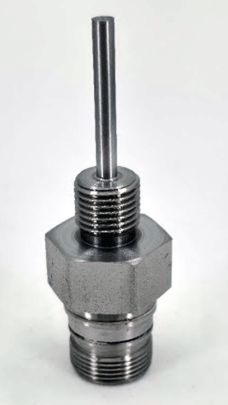
At the core of the TS1000 is a platinum Resistance Temperature Detector (RTD), a device whose electrical resistance varies predictably with temperature.
R(T)=R0(1+αT)
This relationship reflects the physical behavior of conductive metals. As temperature increases, lattice vibrations within the platinum element intensify, increasing electron scattering and therefore electrical resistance. The result is a highly stable and nearly linear response over a wide temperature range.
Platinum is selected not only for its linearity, but for its chemical inertness and long-term stability. Unlike other sensing technologies, RTDs exhibit minimal drift over time, making them well suited for applications where calibration integrity is critical.
The operating range of the sensor goes from -40F to just over 300F and is IP67 rated. Termination to a MIL-DTL-38999 Series III connector is standard, but custom terminations can be applied at the factory.
While RTD elements are well understood in laboratory conditions, maintaining their accuracy in real-world environments presents a significantly greater challenge. The TS1000’s design reflects a series of engineering trade-offs aimed at preserving measurement fidelity under severe mechanical and environmental stress.
A key consideration is the balance between thermal coupling and mechanical survivability. Accurate sensing requires efficient heat transfer between the measured medium and the RTD element, yet direct coupling can expose the element to damaging vibration and shock. The TS1000 addresses this through a probe design that promotes rapid thermal response while mechanically supporting and protecting the sensing element.
Environmental sealing is equally critical. Moisture ingress, particulate contamination, and corrosion can all introduce resistance errors that exceed the sensor’s accuracy specification. The TS1000 employs a hermetically sealed stainless-steel housing, maintaining isolation from the external environment while ensuring long-term stability.
Vibration and shock resistance are addressed through compact geometry and internal strain management. In high-vibration environments such as rotorcraft or ground vehicles, sensor mass and internal support structures directly influence survivability. By minimizing mass and reinforcing internal connections, the TS1000 mitigates common failure modes such as lead fatigue and element fracture.
Thermal cycling introduces additional complexity. Repeated expansion and contraction can degrade seals and alter mechanical stresses within the sensor. Careful material selection and coefficient-of-expansion matching ensure that the TS1000 maintains calibration stability across its operating range.
The TS1000 is designed to operate across a temperature range of approximately -40°C to +150°C, with high accuracy and repeatability. Its response time, on the order of seconds, reflects a balance between sensitivity and mechanical robustness. The sensor outputs a passive resistive signal, allowing integration with a wide variety of measurement systems without the need for onboard electronics.
This passive architecture offers an additional advantage: immunity to electromagnetic interference and reduced failure points, both of which are critical in aerospace and defense applications.

This comparison highlights the fundamental distinction: while thermocouples offer speed and switches offer simplicity, the TS1000 delivers a combination of accuracy, stability, and ruggedness that supports advanced system-level analysis.
In rotorcraft systems such as those produced by Bell Helicopter, oil manifolds play a critical role in distributing lubrication throughout the drivetrain. These systems operate under demanding conditions, including elevated temperatures, pressure fluctuations, and continuous vibration.
Traditionally, thermal switches have been used to indicate over-temperature conditions within the oil manifold. While effective for safety shutdowns, this approach provides limited visibility into the system’s thermal behavior. Engineers are unable to observe gradual temperature increases, transient spikes, or localized inefficiencies which could enable more sophisticated thermal responses. An example of how this might be acheived is shown below for the oil manifold of a typical helicopter engine.

By integrating a TS1000 sensor into the oil manifold, continuous temperature data becomes available. This enables detection of subtle changes such as:
In practice, this data can be fed into onboard monitoring systems or maintenance diagnostics, allowing operators to identify potential issues before they result in failure. The rugged construction of the TS1000 ensures that this capability is delivered without compromising reliability, even in the presence of vibration, oil exposure, and thermal cycling.
The CPI TS1000 represents a meaningful advancement in thermal sensing technology. By combining the inherent accuracy and stability of platinum RTD elements with a mechanically robust, environmentally sealed design, it extends precision measurement into harsh environments traditionally dominated by simpler switching devices.
This transition from discrete setpoint detection to continuous sensing enables a new class of thermal management strategies. Engineers gain access to richer data, improved diagnostic capability, and greater control over system behavior. In applications such as aerospace oil systems, where reliability and insight are equally critical, the TS1000 provides a foundation for more informed and proactive decision-making.
As systems continue to evolve toward greater complexity and performance demands, the ability to measure—not just detect—temperature will become increasingly essential.
